
There is a story about a boy called Tom Sawyer.
He is a mischievous lad who appears in a novel by Mark Twain. One day, his aunt makes him paint the fence as a punishment. It’s a tedious job. Yet Tom deliberately made it look as though he was enjoying himself.
Before long, his friends started gathering round. ‘Let me have a go too,’ ‘I want to have a go as well.’ Before he knew it, Tom wasn’t doing a thing, whilst his friends were busily painting away.
If you impose something as an obligation, people won’t take action. But if it looks like fun, people will start taking action of their own accord.
There is another episode similar to this one.
This is a true story set in South Africa.
An infectious disease was spreading in that area. It was known that this could be prevented by getting into the habit of washing one’s hands with soap. However, despite education and awareness-raising campaigns, the habit failed to take root. Even though they were constantly told to ‘wash your hands’, the children did not use soap.
It was a project called HOPE SOAP that changed that situation.
For that project, a mechanism was used whereby toys were enclosed inside the soap. Toys that children would love, such as toy cars and figurines, were encased within the soap. The only way to retrieve the toys was to use up all the soap surrounding them.
The children were absolutely fascinated. They rubbed the soap vigorously into their hands and all over their bodies. They dissolved it in water. They just wanted the toy to appear as soon as possible. Driven by that single thought, they used the soap every day.
It has been reported that this resulted in an increase in the frequency of handwashing, which made a significant contribution to the prevention of infectious diseases.
When I first heard this story, something just clicked.
Some might criticise this as ‘abandoning education in favour of luring children with toys’. But I don’t see it that way.
The children were not forced to use soap. They took the initiative because they wanted the toys. That behaviour ultimately led to a reduction in infectious diseases.
Habits that are forced upon us don’t last. But things we do because we enjoy them do stick. Actions born of joy are stronger than those born of duty.
When I first heard this story, I thought it was exactly the same as what we’d been doing at FARM8.
I’ve worked on a project based on a similar concept. It was called the ‘Children’s Lunch Revolution’.
Children’s set meals are dishes that children love. However, when you look at the ingredients used, they have little to do with local farmers and contain a lot of additives. Many of these meals are not particularly beneficial for children’s health or for the local community.
So, we decided to try to increase the number of restaurants offering children’s meals made exclusively with home-grown ingredients and containing as few additives as possible.
As part of the event planning, we also set up a stall like this. We made all the traditional festival fare—such as takoyaki and shaved ice—using entirely local ingredients. What if the kind of street food that children rush to buy was, in fact, good for both their health and the local community?
Simply telling children, ‘Let’s learn about food’ won’t get them to take action. But when they see a delicious and fun food stall, they’ll run straight over. What they ran to eat turned out to be the bounty of the local area.
It’s just like HOPE SOAP. The children who used the soap because they wanted a toy, and those who ran to the stall, were both doing the same thing. They took the initiative, and before they knew it, they were doing something good for their health.
If children are drawn to shops that sell hamburgers with free toys, perhaps we could take inspiration from that approach and see if we can adapt it into something that’s good for both our bodies and society. Something that’s fun, tasty and good for the local community. I still believe that there must be a place out there where all these elements come together.
And that philosophy continues to be reflected in both the world of sake and the world of fireworks.
There was a problem with accommodation for the Nagaoka Fireworks Festival. As one of Japan’s three great fireworks displays, it attracts visitors from all over the country, yet there aren’t enough places to stay nearby. What’s more, taking young children to the fireworks venue is far more challenging than one might imagine. There are huge crowds, long queues for the toilets, children getting lost in the pitch dark, and little ones who end up crying because the noise is simply too loud.
But I wanted you to see the Nagaoka Fireworks with your own eyes.
We invited people to come and watch the fireworks whilst camping halfway up Higashiyama, on the opposite side to the fireworks venue. Although it’s from a distance, this is the Nagaoka Fireworks Festival as seen from the mountain. What’s more, we transported 10 tonnes of snow up to the mountain in the height of summer to create a place where children could play in the snow.
This isn’t a call to solve the accommodation problem. It’s a call to go camping in the mountains, have fun in the snow and watch the fireworks.
Five hundred people gathered. A crowd roughly equivalent to the capacity of a large hotel spent the night pitching tents in the mountains. As a result, it served as a refuge for those who had nowhere else to stay.
Before I knew it, I was working on my Nagaoka Fireworks homework.
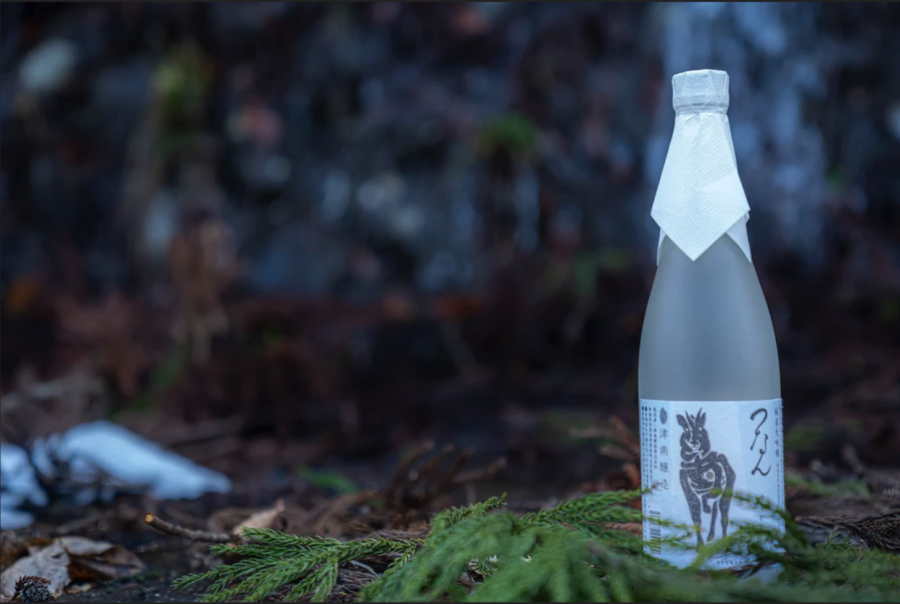
For example, there is a product that was born from the idea that it might be interesting to enjoy fruit alongside sake. It wasn’t created with the aim of popularising sake. The priority was simply that it should be enjoyable to drink and a welcome gift. However, as a result, it has become a gateway for young women who had never tried sake before to discover it.
Whilst I was simply enjoying myself, I found myself solving the challenges facing the sake industry.
Some products have been created simply out of the pure joy of thinking, ‘It would be brilliant to drink sake whilst camping.’ We wanted to take some delicious sake up into the mountains. We wanted to drink sake by the campfire. That was our initial motivation. But as a result, new opportunities have emerged in places where sake had never been available before.
Without even realising it, I’d created a whole new market.
The reason the children used HOPE SOAP wasn’t to prevent infectious diseases. It was because they wanted toys.
The people who gathered for the Nagaoka Fireworks Festival camp weren’t there simply to solve their accommodation problems either. They were there because they wanted to enjoy themselves in the mountains.
Even those who enjoyed the fruit and sake weren’t setting out to save the sake industry. It was simply because it looked delicious.
However, that enjoyment ultimately helped to address local issues.
When I think about local issues, I sometimes find myself wondering ‘how can we make this fun?’ before asking ‘how can we solve this?’.
If it’s not fun, you won’t stick with it. And if you don’t stick with it, nothing will change.
I was just having a bit of fun, and before I knew it, I was working on my homework.
I hope to continue creating such initiatives in the future.
ATSUSHI KABASAWA
FARM8 Co. Ltd.,