
In #1, I wrote a proposal suggesting whether we could open up another outlet for rice. The idea is to make rice intended for consumption available for use by local sake breweries as well.
Before that, there is something I would like to check.
To begin with, why has it become the norm to brew sake using sake rice varieties such as Yamada Nishiki and Gohyakumangoku?
The use of sake rice appears to be a long-standing tradition. However, when one looks at the sequence of years, it turns out that it is not actually that old a practice.
In the old days, they couldn’t polish rice as much as they do now.
In today’s sake industry, the rice polishing ratio has become the key figure used to indicate quality. For Daiginjo, it is 50 per cent or less; for Ginjo, 60 per cent or less. It is not uncommon to find sake polished down to the 30 per cent range.
It is not as though this method of rice polishing has always been possible.
In the past, rice was polished using water wheels or by foot. It is difficult to remove the outer layer of the rice grain uniformly down to nearly half its thickness. It is said that, with the technology available at the time, the maximum amount that could be removed was around 70 per cent.
In other words, this means that the vast majority of sake produced during both the Edo and Meiji periods was brewed using rice polished to a rate of 70 per cent or more.
1930: A change in rice-polishing machinery
The turning point came in the early Shōwa period.
In 1930, Rishi Satake of Saijō in Hiroshima Prefecture completed the development of a vertical grinding-type rice polisher. This machine was capable of precisely removing the outer layers of the rice grain without significantly altering its shape. Whilst water-powered mills could only achieve a maximum polishing rate of 70 per cent, this machine made it possible to polish the rice down to 40 per cent.
The outer layer of rice contains relatively high levels of proteins and lipids, which influence the flavour and aroma of the sake. By removing this outer layer and using a larger proportion of the starch from the centre, it becomes easier to achieve a clean-tasting sake.
Once it becomes possible to mill the rice to a greater extent, the next requirement is a variety of rice that is less prone to cracking even when heavily milled. There is a growing demand for rice that is easy to use in making koji and whose water absorption and fermentation characteristics are predictable.
It wasn’t the case from the outset that ‘special rice was needed for sake’. It was the invention of the polishing machine that created the need for rice suited to making the most of that technology. I believe this sequence of events is more accurate.
1936, Yamada Nishiki
It was against this backdrop that Yamada Nishiki was developed.
The cross-breeding took place in 1923 at the Hyogo Prefectural Agricultural Experiment Station. After crossing ‘Yamada Ho’ with ‘Tankō Watatsuki’ and undergoing a series of selection rounds, the variety was named ‘Yamada Nishiki’ in 1936 and has since been designated as a recommended variety by Hyogo Prefecture.
The grains are large, with a distinct white core, making it easy for koji mould to penetrate. It is resistant to cracking, even when heavily polished. This rice is easy to work with in the sake-making process.
On the other hand, it grows to a height of around 130 centimetres, is prone to falling over and is susceptible to disease. Compared to rice grown for consumption, it is also more difficult to cultivate.
1957, five million koku
Niigata’s Gohyakumangoku is also a variety that was bred in the same way.
The cross-breeding took place in 1938 at the Nagaoka Main Station of the Niigata Prefectural Agricultural Experiment Station. A cross was made between Kikusui and Shin No. 200, and in 1944 the strain was given the designation ‘Hybrid No. 290’; however, research was interrupted by the war.Following the resumption of research, the first trial brewing took place in 1956, and the variety was released to the public the following year, in 1957.
The name derives from the fact that rice production in Niigata Prefecture exceeded five million koku.
It does not dissolve too readily in the moromi, making it easier to produce a crisp sake. This became one of the key factors underpinning the ‘light and crisp’ character that would later come to define Niigata sake.
Although ‘Gohyakumangoku’ now seems to be a Niigata tradition, its history as a rice variety spans only about 70 years.
Around 1975, ginjo sake began to appear on the shelves
There is another year worth noting.
Ginjo sake came into being with the development of machinery capable of extensive polishing and the creation of rice varieties particularly suited to the polishing process. However, it was not until around 1975 that it began to appear on the market. Prior to that, ginjo sake was a special type of sake produced solely for submission to competitions. It was not until the 1980s that it became widely available.
In other words, it has only been about 50 years since the notion that ‘the thinner it is, the more luxurious it is’ became firmly established in society.
For reference, shipments of sake peaked in 1973. This means that , at the height of its popularity, ginjo sake was not yet available in shops.
The rice polishing ratio was the reason for the price.
It’s not just a question of varieties and techniques.
From the post-war period to the present day, the rice polishing ratio has become a value indicator that is easy for consumers to understand. As the figure decreases—from 50 per cent to 40 per cent to 35 per cent—more of the rice is removed, which reduces the efficiency of raw material utilisation and makes the polishing process more time-consuming. This figure makes it easy to explain why the price is higher.
If the market for ginjo and daiginjo sake expands, the value of the sake rice suitable for producing these grades will also rise. As breweries require this rice, farmers will grow it.
The cultivation of sake rice, rice polishing techniques, brewing techniques, the quality of sake sought at competitions, the ‘polishing ratio’ as a benchmark, the regions where the rice is grown, and contracts between breweries and farmers. These are not separate phenomena. The current structure of the sake industry has been shaped by these elements, each supporting the others.
It wasn’t as though anyone had decided to ‘share it out’
When you look at the era names lined up like this, the current structure seems quite logical.
Breweries receive sake rice that they know exactly how to handle. Farmers have breweries that buy their rice. Both the equipment and the techniques have been developed specifically to suit this raw material. Sake retailers can describe their products using terms such as ‘Yamada Nishiki’, ‘Gohyakumangoku’ and ‘polishing ratio’. Consumers, too, can use these terms as criteria when making their choice.
It wasn’t as though someone decided one day, ‘Let’s separate the rice we eat from the rice used for sake.’ Rather, as a result of developing the technologies and systems required in each era, the rice on our dining tables and the rice in the sake breweries gradually came to exist in separate worlds.
This system has worked well for a long time.
Therefore, I do not believe it is correct to explain the fact that little sake is made from rice intended for consumption by saying that ‘the industry is outdated’. There are reasons within the current structure that have led to this situation.
A warehouse funded by 300 investors; there are now two premises there
However, the circumstances have changed between the time when that system was established and the present day.
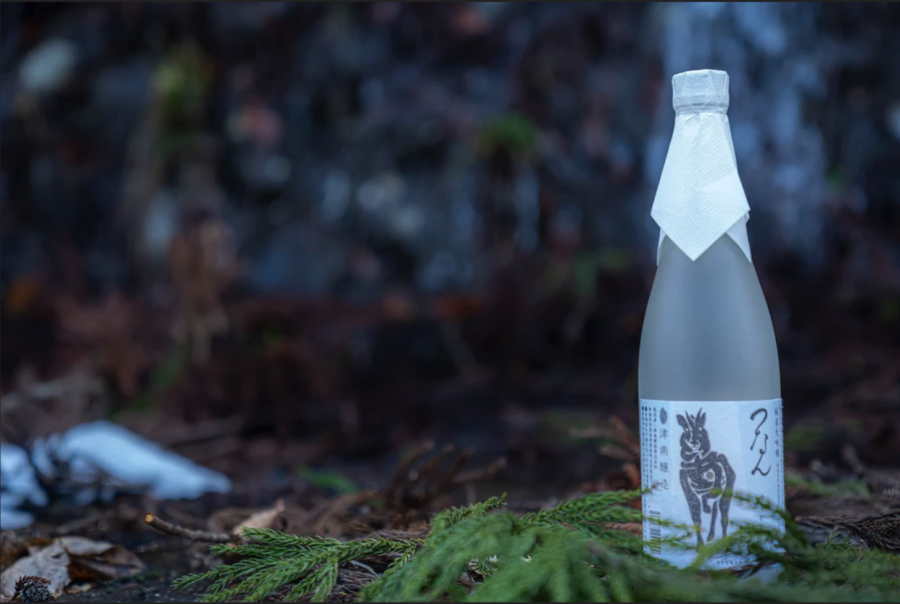
Tsunan Brewery, with which I have been involved, is a sake brewery established some 30 years ago through investment from over 300 local farmers. It was founded on the principle of not merely sending locally grown Gohyakumangoku rice out of the town as raw material, but of turning it into sake right here in the local community.
However, back when I was talking about Koshihikari brewing, the number of farmers in the village growing Gohyakumangoku had fallen to just six. Since then, the number has fallen further, and there are now only two.
Of the more than 300 farmers who work at the brewery, two grow rice specifically for sake production.
Meanwhile, Tsunan is a producing area for Uonuma Koshihikari rice. There are farmers in the region who grow rice for consumption.
Should we protect the five million koku, or preserve the relationship between the region and the brewery?
This raises a question.
Is it necessary for this sake brewery to continue using a specific variety, such as Gohyakumangoku, in order to maintain its connection with local agriculture? Or should it instead use the rice grown locally at any given time to brew sake in the region?
I think the answer varies depending on the region and the brewery. However, it is certainly possible that the latter is the case.
It is not simply a matter of replacing the sake rice with Koshihikari. We will continue to produce sake made with Gohyakumangoku whilst also brewing sake using Koshihikari. Rather than limiting ourselves to a single raw material, we are expanding our options.
What we now take for granted has come about in less than 100 years.
Sake rice, rice polishing techniques, evaluation criteria and the systems for dealing with farmers have all been developed in response to the challenges of their respective eras.
Machinery was developed in 1930, the Yamada Nishiki rice variety was created in 1936, the Gohyakumangoku variety was developed in 1957, and from around 1975, ginjo sake began to appear on shop shelves. In less than a century, the conventions we take for granted today have taken shape.
When you think about it that way, preserving the current system and introducing new options are not mutually exclusive.
The issue is not the concept, but whether it can actually be built.
The rice used for eating differs in character from that used for sake. Koshihikari is sticky, and special care is required when making the koji. If one were to attempt to brew it using rice polished to around 90 per cent—the same as that used for table rice—this would present a different set of challenges.
In #3, we’ll organise the technical aspects.
Excerpt from the book *Rice Brewing*
CEO of FARM8 ATSUSHI KABASAWA