
There are issues in the local area that remain unresolved.
It’s not because nobody is struggling. There are people who are struggling. And there is a solution out there somewhere. Yet nothing is being done.
Why is that?
For a long time, I thought the reason was money. I believed that as long as we had the funds, we could make things happen; that grants would solve the problem. But the more I got involved on the ground, the more I realised it wasn’t just that.
What is lacking is a perspective that allows us to recognise things that are not yet perceived as having value.
There are things in a community that we have become so accustomed to that we no longer recognise their value. Although both people and resources are there, no one has yet discovered a new way of seeing their value. Consequently, the challenges remain unresolved.
By changing your perspective, burdens become resources. Challenges become opportunities.
At the root of this way of thinking lies an interest in the word ‘economy’.
The etymology of the word ‘economy’ lies in the phrase ‘keisei-saimin’. To govern the world and save the people. Improving society was, in fact, the original meaning of the term ‘economy’.
Merchants in the Edo period believed that their role was to support local communities whilst making a profit. Sake breweries nurtured local culture whilst producing sake. Farmers protected the land whilst providing food. Greengrocers brought people together whilst selling produce. Running a business and improving the local community were, from the outset, one and the same thing.
Before we knew it, we had drifted apart.
As modernisation progressed and companies grew in size, there was an increasing emphasis on efficiency and profit. Situations in which figures took precedence over the impact on local communities became more common. It was against this backdrop that companies came to be defined as entities existing for the sake of profit.
Consequently, a backlog of challenges began to build up that companies were reluctant to tackle. Challenges with no apparent market potential. Activities that did not generate profit. Investments that could not be recouped in the short term. These came to be regarded as ‘not the company’s job’.
The NPO model was created to fill that gap. It has become widespread as a type of organisation that is not profit-oriented and whose mission is to tackle social issues.
And so, the roles were divided. Companies exist to make a profit. NPOs exist to tackle social issues. The government exists to serve the public.
However, I find this classification a little odd.
To begin with, was it really for the sake of social contribution that sake breweries nurtured local culture? Was it for the sake of NPO activities that farmers continued to protect the land? I don’t think so. Simply doing one’s job properly was, in itself, a contribution to the local community. Business and social contribution were surely not meant to be considered separately.
Furthermore, it surely isn’t the case that NPOs tackle social issues simply ‘because companies don’t’. As organisations that recognise issues sooner than anyone else and can act more swiftly than anyone else, they stand at the forefront of their local communities. Isn’t that the very essence of an NPO?
To improve the local community whilst generating profit. As the local community improves, profits are sustained. By combining the perspectives of these three parties, we draw out the value that lies dormant within the local community. I believe that designing this cycle is the true role of a company.
I have respect for NPOs, public authorities and businesses alike.
The strength of NPOs lies in their instinct for identifying issues. It is NPOs that are the first to notice the suffering that no one else has yet recognised as a problem. Driven by a sense that ‘this cannot be ignored’, they act as a early warning system, enabling them to get on the ground before the government takes action. This ability to shine a light on areas that society has not yet recognised as problems stems from human compassion—something that cannot be created by institutional frameworks alone.
On the other hand, we have also seen that there are challenges regarding sustainability. Goodwill endures. However, funding and resources are finite. When grants run out, the work stops. When those involved become exhausted, the work stops.
The strength of public administration lies in its fairness and continuity. Once an issue is recognised as affecting many people, a system of ongoing support can be established.Once a system is in place, it continues even if the organisation responsible changes. That stability and scale are strengths unique to the public sector. However, it is difficult to address issues that have not yet been recognised as such by anyone. This slowness is not a flaw, but rather a structural mechanism designed to safeguard fairness; nevertheless, it is not well-suited to taking the first step.
A company’s strength lies in its ability to establish systems and sustain them. If there is market potential, the business can continue even without subsidies. When new value is identified, the company has the capacity to turn it into a viable business. However, it cannot take action unless market potential is evident. Even if there is value, the company cannot move forward unless it can translate that value into market success.
Of course, NPOs, local authorities and businesses are not the only organisations active in the local community.
Farmers have their role to play. Sake breweries have theirs. Universities have theirs. Financial institutions have theirs. Neighbourhood associations, chambers of commerce, schools and local media all have their respective roles to play.
Each of them is looking at a different view.
Farmers view the local community through the lens of their fields. Local authorities view the local community through the lens of their systems. Businesses view the local community through the lens of the market. Universities view the local community through the lens of research. NPOs view the local community through the lens of the issues at hand.
Consequently, the challenges we perceive differ, as does our sense of what constitutes value. For farmers, justice means growing good crops. For the government, justice means being fair. For an NPO, justice means not abandoning those in need. For a company, justice means creating a sustainable system. All of these are correct. Yet it is precisely because they are all correct that our perspectives diverge.
The reason I write about NPOs, local government and businesses is not because these three entities are in any way special. I cite them as clear examples to help people understand that different perspectives exist within a community depending on one’s position.
When multiple perspectives come together, we can uncover value that we would not have been able to discover on our own. That is why each individual’s presence is essential.
In reality, however, each tends to operate solely within its own framework. NPOs speak in the language of NPOs, companies operate according to their own logic, and the public sector proceeds through its own procedures. Even though they are all looking at the same local area, what they see differs so greatly that they simply cannot communicate with one another.
By standing between them and interpreting each perspective, we can discover new meanings. I believe that is where the role of local businesses lies.
Before starting my business, I was involved in support programmes run by an NPO.
The issues identified by the NPO were genuine, and the passion of those involved was genuine too. However, there was no system in place to ensure its sustainability.
There is a shortage of people capable of transforming the value identified by NPOs into sustainable initiatives.
I might be able to fit in there.
It was with this in mind that we launched FARM8 in 2015.
My initial idea was a concept I called the ‘Food-Style Company’.
It is a system whereby farmers convert surplus produce into tokens, and the profits generated from processing and selling that produce are redistributed to participants.
At the time, I also felt that blockchain technology held great potential, and I thought it was a very interesting idea from a technical perspective.
However, when I spoke to the farmers on the ground, our views didn’t align at all.
What farmers were looking for was a solution to the challenges facing agriculture, not a token-based system.
It was all just theoretical musings.
Value cannot be found at a desk.
It is only by going out into the field, listening to the local people, and finding out what problems they face and what they hope for that one can truly gain an insight.
That was the lesson I learnt from my first failure.
Looking back now, perhaps I wasn’t trying to find value, but rather trying to invent a system.
As an adviser on projects linked to the Ministry of Agriculture, Forestry and Fisheries, I became involved in supporting the sixth-sector industrialisation of agriculture and began providing consultancy services to farmers and food businesses across the country.
What became apparent was that each region faced its own unique challenges, alongside a richness found nowhere else.
In various regions, there were locally sourced materials and techniques, and people who approached craftsmanship with sincerity.
Everyone continued to hone their own strengths.
However, I also felt that the mechanisms and functions required for that value to be linked to other values and perceived as a new meaning had not yet fully developed.
It is not that there is a lack of value. On the contrary, each individual element of value already shines brightly enough. It may simply be that there are too few people or systems capable of linking them together and conveying their meaning.
Looking back now, I realise that what I was searching for was not a new star, but the lines connecting the stars that were already there.
That perspective first took shape in the pairing of non-standard fruit with sake.
Even fruit labelled as ‘substandard’ tastes no different; the only difference is in its appearance. Farmers have been making use of it in various ways, such as selling it for processing or consuming it themselves. The mere fact that it is labelled ‘substandard’ does not mean that it has lost its intrinsic value.
Meanwhile, consumption of sake had been falling steadily.
It isn’t reaching the younger generation.
I don’t have a reason to drink.
The sake brewery was aware of these challenges.
Non-standard fruit already had value.
The farmer knew that.
Sake already had its own value.
The sake brewery knew that.
It wasn’t value that was lacking.
It was a line connecting the two.
Fruit that does not meet standard specifications could well become a new gateway to sake.
Sake may offer new ways to enjoy it when paired with fruit.
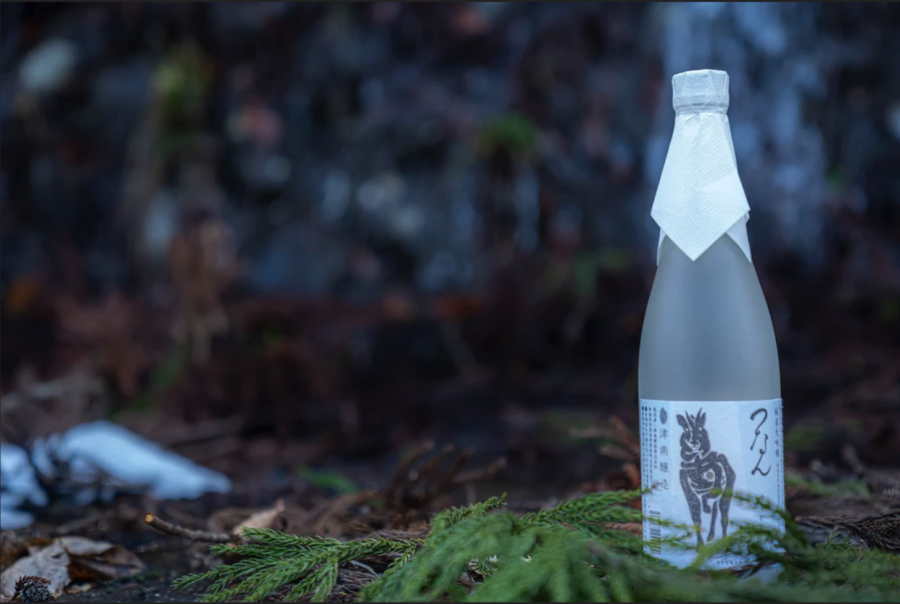
And that is how ‘Ponshu Guria’ came into being.
There are now more outlets for farmers.
The sake brewery was able to propose new value.
It even appealed to people who didn’t usually like sake.
The sellers also made a profit.
So it continued the following year as well.
Before we knew it, cumulative sales had exceeded 900,000 bottles, and fruit that had previously been deemed substandard became available to a wider audience; this led many people to try sake for the first time.
This was not merely a matter of product development. We discovered new meaning between existing values. The resulting system has certain distinctive features.
The key is that everyone involved stands to benefit in their own way. A system that relies solely on one person’s goodwill will grind to a halt when that person reaches their limit. A system in which only one party bears the burden is bound to collapse as a result of the imbalance it creates.
Only systems that benefit everyone will be passed down to the next year, and the year after that.
I learnt one more important thing.
As awareness of the product has grown, we have received an increasing number of requests from fruit growers asking us to produce products using their own fruit.
Back then, I was trying to create a system that would enable farmers to become entrepreneurs.
But the farmers’ true feelings were quite different. They simply wanted to concentrate on growing and shipping their fruit.
Perhaps I was trying to turn farmers into entrepreneurs. But what the farmers were really looking for was an environment where they could focus on farming. If farmers can devote themselves to farming, that is enough.
That’s when I realised something. I had been trying to strip the other person of their values and impose my own upon them. I realised that I had been trying to arbitrarily rewrite the very meaning of what it means to be a farmer.
Farmers should be allowed to remain farmers. My role was to create an environment in which they could take pride in their work and focus on farming.
Not everyone needs to become an entrepreneur. Nor does everyone need to take on the role of solving problems.
Farmers farm. Sake breweries brew sake. NPOs identify issues. Local authorities put systems in place. Companies give meaning tangible form through their business activities.
When everyone is true to themselves, the value of the community as a whole increases. It is not a case of one person taking over another’s role; rather, when everyone shines in their own way, the community becomes a richer place. I believe that creating such a framework is the role of local businesses.
It reminds me of the constellations.
Stars have always been in the night sky. But the moment someone drew lines between them and gave them meaning, the constellations were born. It was not the creation of the stars that gave rise to them; it was the attribution of meaning. For those who read the seasons for the sake of farming, the constellations became a calendar. For seafarers, they became a map. The same stars took on entirely different meanings depending on who ascribed that meaning to them.
I think the same applies to local communities.
A farmer is a star. A sake brewery is a star. An NPO is a star. The local government is a star. A university is a star. A financial institution is a star. Neighbourhood associations, shopping streets and new residents—each is a star in its own right.
Connecting those dots and discovering new meaning—that is the role of local businesses.
Pon-shu Guria came into being when a line—one that no one had ever seen before—was drawn between the ‘non-standard fruit’ star and the ‘sake’ star. It was not FARM8 that created these stars. Rather, it gave new meaning to the stars that were already there.
For me, community-based business is about identifying things whose value has not yet been recognised, giving them new meaning, and establishing systems to ensure their long-term sustainability.
There are things in this neighbourhood that we’ve grown so used to seeing that we no longer notice them. There are things so commonplace that they don’t even have a name. There are constellations that no one has yet drawn a line through.
It is not a matter of creating new value, but of rediscovering the value that was already there.
Finding meaning once again in the stars scattered across the region. And turning that into a sustainable system. For me, regional business is the work that makes that possible.
ATSUSHI KABASAWA
FARM8 Co. Ltd.,
Next chapter: ‘Regions That Become Constellations’ – Chapter 14: How the Little Lights Keep Shining